Someone tells you there is a form of yoga where you lie on the floor under a blanket for forty minutes and do not move. It sounds like a joke at the expense of yoga.
It is not. Yoga nidra is one of the oldest and most specific practices in the tradition, and for a particular kind of tired person it does more than any class will.
What it actually is
You lie on your back, comfortable and warm, and a teacher talks. That is the outward form of it.
What the voice is doing is guiding your attention through a fixed sequence — first around the body part by part, then through the breath, then through other stages depending on the style. Your only task is to follow the voice and stay just awake.
It is often translated as "yogic sleep", which is a poor translation that causes most of the confusion. You are not asleep. You are in the narrow band between waking and sleeping, held there deliberately for longer than ordinarily happens, and kept there by the voice.
Not meditation, and this matters
The distinction is the reason many people who have failed at meditation succeed at this.
In most meditation you are asked to do something: hold attention on the breath, notice when it wanders, bring it back. There is an effort, and there is a way to feel you are doing it badly.
In yoga nidra you are asked to lie still and listen. The structure is provided from outside. When your mind wanders — it will, constantly — the voice is still there and picks you back up. There is nothing to maintain and correspondingly nothing to fail at.
If you have concluded you are bad at meditation, this is the practice to try before you conclude anything.
What a session looks like
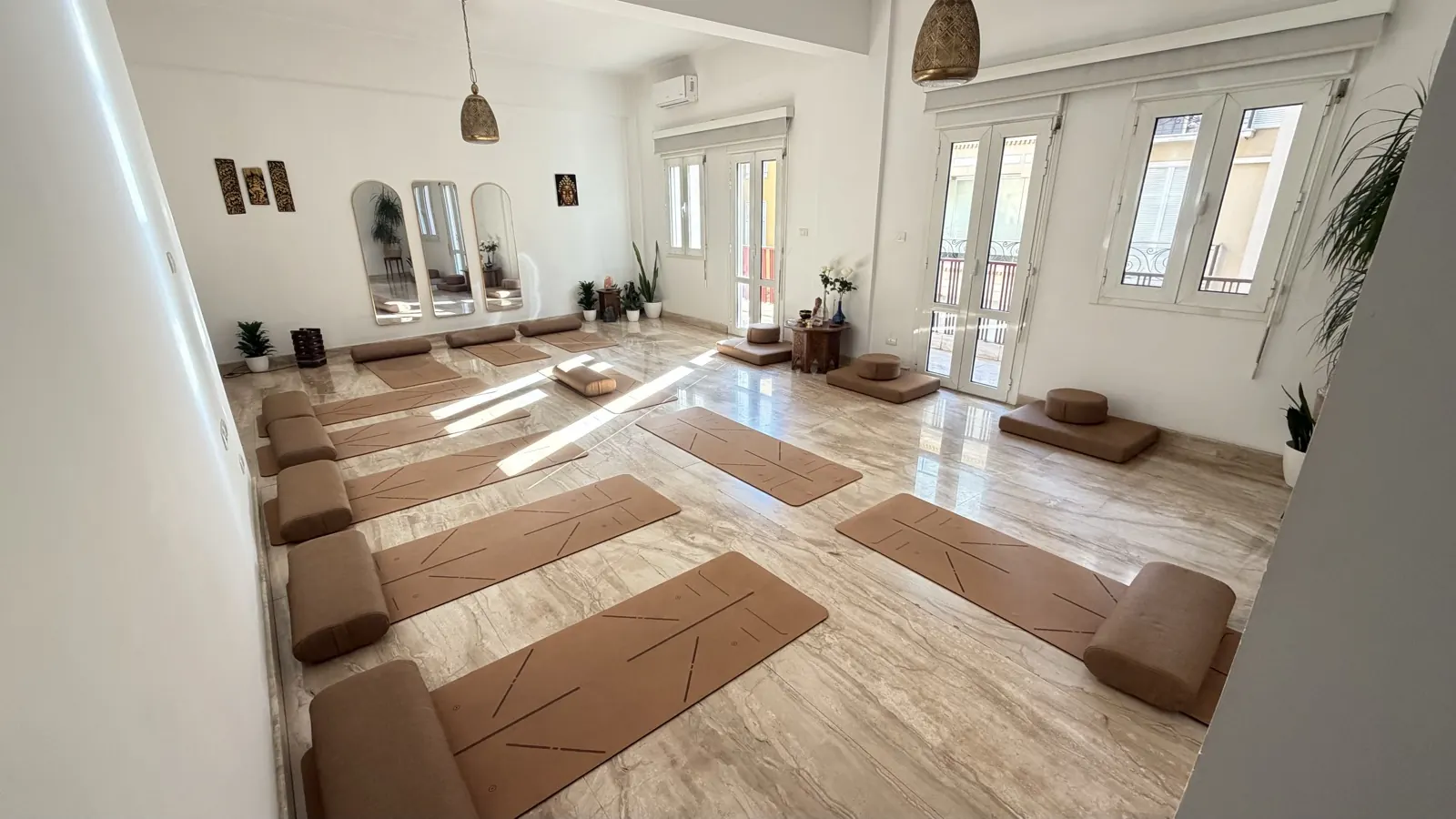
Setting up, five minutes. Flat on your back, a bolster under the knees to release the lower back, blanket over you, eye pillow if you want one. You will cool down while lying still, so more covering than you expect. Getting comfortable is the whole of the preparation, because you will not move again.
A resolve. Many traditions ask you to name a short, present-tense intention at the beginning and repeat it at the end. Something plain — I am at ease. If it feels contrived, and it does to plenty of people at first, you can skip it and the practice still works.
Rotation of consciousness. The core. The teacher names parts of the body in a rapid fixed order — right thumb, second finger, third finger, palm, wrist — and you move your attention to each as it is named, without moving. It is oddly absorbing and it is the part that does most of the work.
Breath awareness. Counting breaths, or following them, without changing them.
Opposites. Deliberately calling up heaviness then lightness, warmth then coolness. This part sounds strange written down and is straightforward in the room.
Coming back. Slow and deliberate. Never sit up quickly from nidra.
The whole thing runs twenty to forty-five minutes.
Yes, people fall asleep
Almost everyone does, in their first few sessions, and often at the same point each time.
This is not a failure and no teacher minds. It usually means you were carrying more sleep debt than you knew, and the practice is doing something useful even if you were not conscious for it. The staying-awake part becomes easier as the debt clears.
If it bothers you: practise earlier in the day rather than at night, keep the room cooler, and lie with your arms slightly away from your body rather than tucked in.
Who it is particularly good for
People who are exhausted rather than stressed. There is a state past stress where a strong class is simply beyond you. Nidra meets that state without demanding anything.
People who sleep badly. Not a treatment for insomnia, and we would not present it as one. But an hour of deliberate rest during the day is available to you even on nights when sleep is not.
People who cannot sit still. Lying down removes the physical struggle that makes seated meditation unbearable for some.
People recovering, injured, pregnant or unwell. Almost anyone can lie down. It is one of very few practices with essentially no physical barrier to entry.
People who find they cannot switch off. The structure does the switching off for you.
Who might find it hard
If lying still with your eyes closed makes you anxious, be aware that it can bring things up rather than settle them. For some people with trauma histories, extended body-focused attention with the eyes closed is not the right starting point. Practising with the eyes open, sitting rather than lying, or with a teacher who knows, are all reasonable adjustments. Tell the teacher beforehand.
If you are looking for exercise, this is not it.
If forty minutes of not moving sounds intolerable, that is worth noticing rather than dismissing. It is usually the strongest argument for doing it.
The sleep claim, handled honestly
You will read that one hour of yoga nidra equals four hours of sleep. It is repeated everywhere and it is not something we can stand behind.
There is real and growing research interest in guided deep relaxation, and people consistently report feeling more rested afterwards than the clock would explain. That is worth having. It is not the same as a measured equivalence to sleep, and a studio that quotes you a ratio is quoting marketing.
What we will say plainly: it will not treat a diagnosed sleep disorder, and if you are sleeping badly for weeks on end, that is a conversation for a doctor rather than a yoga teacher.
Doing it at home
This is one of the few practices that works genuinely well from a recording. There are good free ones. Practising at home between sessions is normal and encouraged in a way that, say, learning a vinyasa sequence from YouTube is not.
The reason to come to a live session at least once is calibration — knowing what the pace should feel like, and having someone answer the questions that come up afterwards.
One thing you can do today
Lie on the floor with your knees bent or supported, set a timer for ten minutes, and slowly name each part of your right hand to yourself in turn: thumb, index finger, middle finger, ring finger, little finger, palm, back of hand, wrist. Then the same on the left. Then both arms. Then stop.
That is a fragment of the practice, and ten minutes of it will tell you more about whether this suits you than the rest of this article.