The real reason people put off a first yoga class is rarely the yoga. It is the fear of walking in wrong — wrong clothes, wrong mat, wrong moment, everyone else clearly knowing something you do not.
So here is all of it, plainly, so that the walking-in part stops being a decision.
The short version
- Wear: anything you can bend in, with a top that stays put. Bare feet.
- Bring: water. A thin layer for the rest at the end. Nothing else.
- Skip: a full meal in the two hours before.
- Arrive: ten to fifteen minutes early, and say it is your first class.
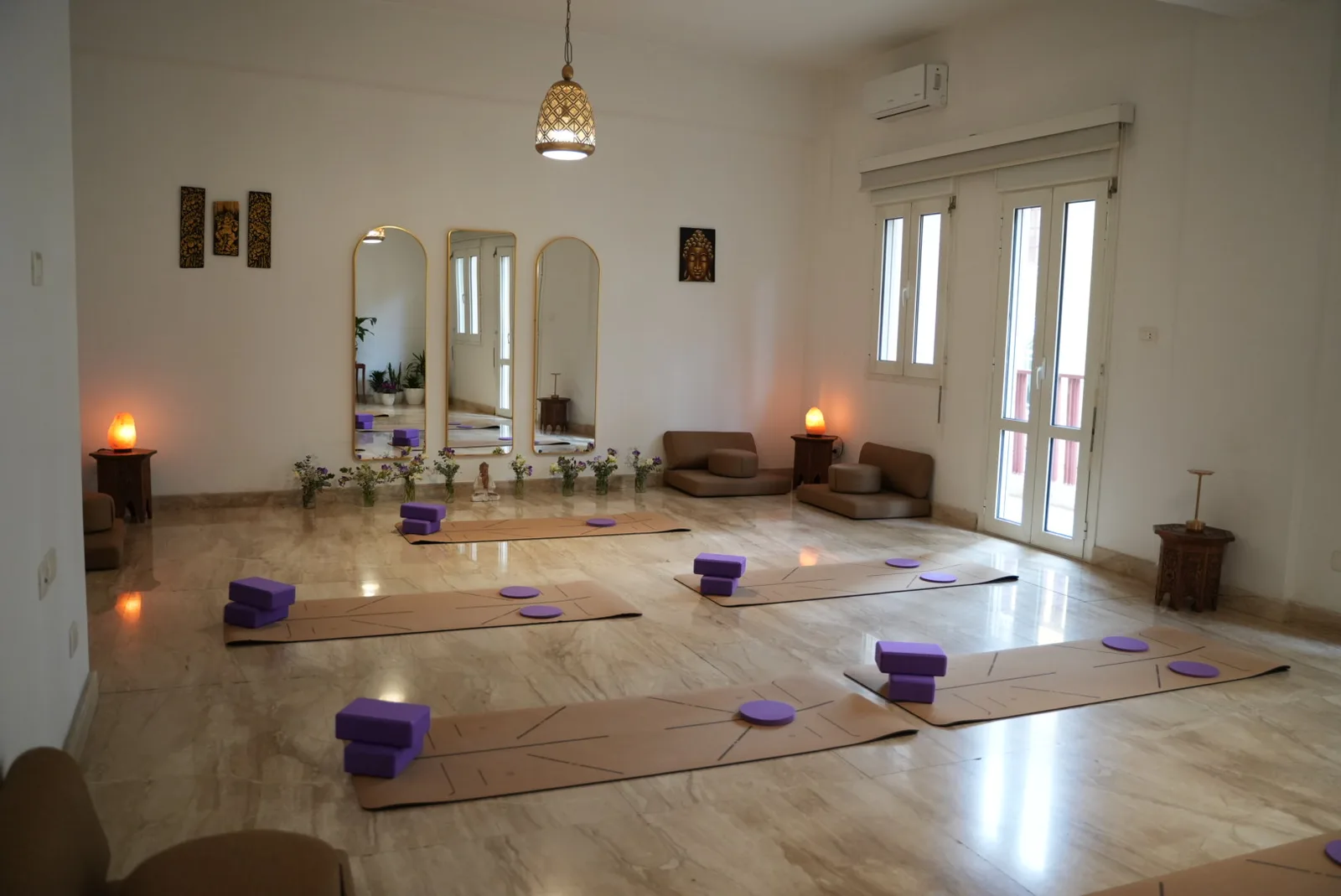
- Mat: provided, along with blocks, straps, knee pads and bolsters. Do not buy anything yet.
The rest of this explains why, and answers the questions people are too polite to ask.
What to wear
Something you can move and bend in. That is the whole requirement.
Leggings, joggers, shorts you are comfortable inverting in, a t-shirt or vest. Clothes you already own. You do not need yoga clothes to do yoga, and nobody in the room will notice what you are wearing.
Three things that genuinely help:
A top that stays put. Anything loose will slide towards your face in a forward fold or a downward dog. Fitted, or tucked in, saves you adjusting it every few minutes.
Bottoms without a hard waistband. Jeans and anything with a stiff button dig in when you fold. Soft waistband, elastic, drawstring.
A supportive bra if you wear one. There is more forward folding and more lying on your front than people expect.
What not to wear
No socks on the mat. They slide, and sliding in a standing pose is how people pull things. Yoga is done barefoot. If you are self-conscious about your feet — many people are, more than will ever say so — grip socks with rubber soles are a perfectly normal solution and nobody will comment.
Nothing slippery. Very silky fabrics slide against the mat.
See-through leggings. Check yours before you leave the house: bend over in front of a mirror in good light. Thin fabric that looks fine standing up can go sheer in a forward fold, and you will spend the class worrying about it instead of breathing.
Take off your watch and any dangling jewellery. They dig in when you put weight through your hands.
Skip strong perfume or aftershave. The room is small and shared and people are breathing deliberately.
Bring a layer for the end
The last five to ten minutes are spent lying still, and your body cools quickly once it stops moving. Even in a warm room, people finish shivering. A light sweatshirt, or a pair of socks to put on for that final rest, makes the ending far more comfortable. Socks are fine there. It is only during the active part that they are a problem.
What to bring
Water. That is genuinely the only essential.
A mat, if you own one. If you do not, do not buy one for your first class. Every studio has mats to borrow, including ours: we use cork mats, which grip better as your hands warm up. Buy one once you know you are coming back, and then buy a slightly better one than the cheapest — a thin mat with no grip makes yoga harder in a way beginners tend to blame on themselves.
A small towel if you sweat a lot or the class is a warm one.
Hair tie, if it applies to you.
Leave everything else. You do not need blocks, straps, bolsters or a special cushion. We provide blocks, straps, knee pads and bolsters if you need one, and the teacher will tell you when to use them.
About eating
Do not eat a full meal in the two hours before. Twisting and folding on a full stomach is unpleasant and can make you feel sick.
Something light an hour or two before is fine and better than arriving empty. A first class on an entirely empty stomach can leave you light-headed, particularly in the heat.
When to arrive
Ten to fifteen minutes early for a first class. Not five.
That gives you time to find the place, take your shoes off, tell the teacher it is your first class, set up a mat without hurrying, and sit for a moment before starting. Arriving flustered at the last second sets the tone for the whole hour.
Practising in Beirut
In summer, choose fabric that breathes. Cotton or technical sportswear, not thick or synthetic-feeling layers. Humidity makes a hard class feel harder, and a small towel earns its place in the bag.
In the colder months, arrive dressed for the street and change into something lighter on the mat. Keep a layer within reach for the final rest.
Plan for traffic, not for the map. The journey that takes ten minutes at midday can take three times that between about 4.30pm and 7pm. Aim to arrive early, or read how to find us in Tabaris, including where to park, before your first visit.
If you are joining by video
Some of our classes run online, including Gentle Yoga for Beginners, so you can practise from anywhere in the world. A few things make the first one easier:
- Clear a space about the size of a mat plus arm's reach on both sides. A rug, a towel on a bare floor or a proper mat all work. Avoid a polished floor with bare feet.
- Prop your phone or laptop at floor level, a couple of metres away, so the teacher can see your whole body. A stack of books is enough.
- Log in five minutes early and say it is your first time.
- Tell the teacher what is around you if you have a low ceiling, a small room or a pet who joins in.
Tell the teacher three things
This is the part that most improves a first class, and most people skip it.
Before you start, say: it is my first class, here is anything wrong with my body — knees, lower back, neck, wrists, pregnancy, recent surgery — and here is whether you want hands-on adjustments.
That last one is worth knowing you can answer. Some teachers physically adjust students' positions. You are entitled to decline, entirely, without explaining. Saying "I would rather not be adjusted today" is a complete sentence and any decent teacher will simply say fine.
Which class to pick first
Class names are not standardised and the names are often the least helpful part. Roughly:
Hatha — slower, poses held longer, plenty of instruction. An excellent first class.
Vinyasa or flow — movement linked to breath, continuous, more demanding. Fine as a first class if you are reasonably fit and do not mind being lost for the first twenty minutes.
Yin — long-held floor poses, several minutes each, deeply passive. Physically easy and mentally quite hard. Very good first class for the stiff and the stressed.
Restorative or yoga nidra — supported rest, almost no effort. If you are exhausted, start here and do not feel you are cheating.
Ashtanga, power, hot — not first classes. Come back to them.
If in doubt, message the studio, describe yourself honestly, and ask which class they would put you in. It takes a minute and gets it right.
At the studio, the gentlest places to start are Gentle Yoga, Hatha Yoga and Yin Yoga & Reiki Energy Healing. Vinyasa Flow is there when you want more movement, and Gentle Hatha & Yoga Nidra when you mainly want to rest. See all our yoga classes or what is on the schedule, and if you are still unsure, our guide to yoga styles explains the differences in more detail.
What nobody tells you
Everyone looks at their own mat. The self-consciousness is real and it is also unfounded. Nobody is watching, because everybody is fully occupied with their own balance.
You will not be able to do some of it. This is not a failure state, it is the normal condition of every person in the room, including the flexible ones. Every pose has an easier version and the teacher will offer it.
Child's pose is always available. At any moment, in any class, without asking permission, you can kneel down and rest. Experienced students do this constantly. It is not giving up; it is the practice working correctly.
You may feel emotional, particularly in hip openers or at the end. It surprises people. It is common and it passes.
The lying-down bit at the end is not optional. Savasana, five to ten minutes flat on your back, is where the class settles. Leaving early to beat the traffic is the one thing that will get you a look.
Afterwards
Drink water. Expect to feel loose and slightly spacey for half an hour. You may ache the next day in places you did not know were muscles — that is normal for the first two or three classes and stops.
If something actually hurt during class rather than felt hard, tell the teacher before you leave. That is information they need.
Quick answers
Do I need to be flexible? No. Flexibility is something yoga builds, not something it asks for at the door. Most beginners cannot touch their toes, and that is exactly who beginner classes are for.
Do I need my own mat? No. Our mats are cork, and we provide blocks, straps, knee pads and bolsters too. If your knees dislike kneeling, ask for the pads.
Can I wear shorts? Yes, as long as you are comfortable in them upside down. Short shorts and downward dog do not always agree.
Should I wear a lot of layers? No. You will warm up within ten minutes. Start light, and keep one layer aside for the end.
What if it is too much? Rest in child's pose for as long as you like. You do not need to ask, and you do not need to explain.
One thing you can do today
Look up one class this week, at a time of day you can realistically get to — not the 6pm class you would need to leave work early for. Send one message saying "it's my first class, which one should I come to?"
That message is the entire barrier. Everything after it is easy.